 GLASTONBURY
 Butterfly-filled summer thanks to West Pennard nettles Tim Phillips
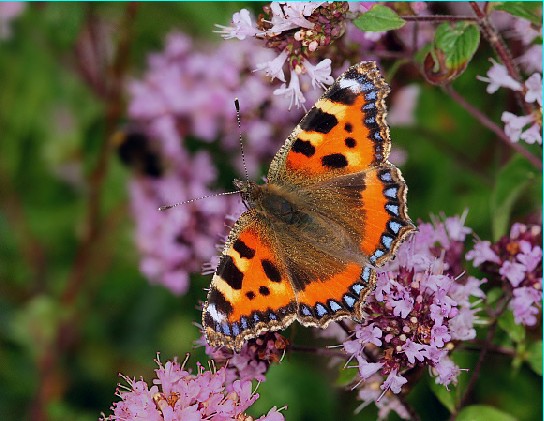
We immediately saw the potential in the garden for butterflies when we moved into our new house in November 2011. Nearby were several buddleias, other nectar sources and caterpillar food-plants, including a number of large nettle stands in the grazing field behind.
In May, realizing that silaging was about to begin, we went into the field and collected around 130 caterpillars in various stages of growth (instars). Within an hour the field was strimmed and no nettles were left standing except for a few poorer ones at the margins.
From years ago, I had kept a couple of breeding cages, and these were soon filled with nettles and hungry insects. Within a week some had pupated and a fortnight or so later began to emerge. This first brood proved to have been heavily parasitized, mainly by Ichneumon wasps and Sturmia bella, a fairly recently identified parasite with a particularly unpleasant life cycle. Nonetheless, about 70 adults flew off.
Keen to do better in the second brood, in early July we collected six first-instar clusters within a day or two of hatching from the eggs laid on the underside of nettle leaves at the top of the plant. These tiny clusters can be identified by what looks like a small closely spun spiderweb, but the silk is actually secreted by the tiny caterpillars at this point not much longer than a millimetre or so. Two new very large breeding cages were ordered online and arrived in the nick of time, because the speed at which the caterpillars grew was astonishing, despite the perpetually miserable summer of 2012.
Our feeding efforts drew attention from the neighbours, who watched us collecting bucketloads of nettles from the field behind with some amusement. In the initial few days before they pupated, we were bringing home six or seven bucketfuls a day with upward of 40 nettles in each. One kind neighbour rang the doorbell twice with some gathered from her own garden.
On July 20 the first pupae were formed, in itself a fascinating process, and within a week nearly 700 hung from the tops of the cages. Two weeks later the miracle of metamorphosis began to reveal itself, and by the end of the following week more than 650 adult small tortoiseshells [Aglais urtica] had been released. Far fewer had been parasitized, perhaps because they were collected at an earlier stage. Between mid-August and mid-November many were seen around the area, and the nettle-supplying neighbour invited us to her garden to show us dozens of “our” butterflies on her dahlias.
Let’s hope that enough adults will have survived the winter to make 2013 year a memorable year for these magnificent creatures and that the weather does its bit too.
Butterfly Conservation, a national charity, has an excellent website at butterfly-conservation.org with lots of information.
Don’t forget to visit Collard Hill in late June as well, to see the Large Blue, a national rarity just on our doorstep. Follow the excellent signs from the youth-hostel carpark at BA16 0TZ.
John Brunsdon adds:
Well done, Tim. Peacock butterflies as well as the small tortoiseshell live in clusters on nettles as caterpillars. If short sleeves of butter muslin are made, the young can be reared inside on growing nettles with the sleeve gently tied top and bottom in safe sites. The sleeve with caterpillars has to be moved to fresh sites as they eat the nettles.
Near chrysalis time, the caterpillars can be moved to upside-down cardboard boxes with a muslin side or top. The chrysalides can be suspended from a sun-lounge ceiling to watch butterflies emerge — fascinating for all ages. I had great fun doing this when living at Hill Head in Glastonbury while my children were small and the field slopes still orchards.
Warning: freshly emerged butterflies drop a staining liquid shortly after emerging and expanding their wings!
